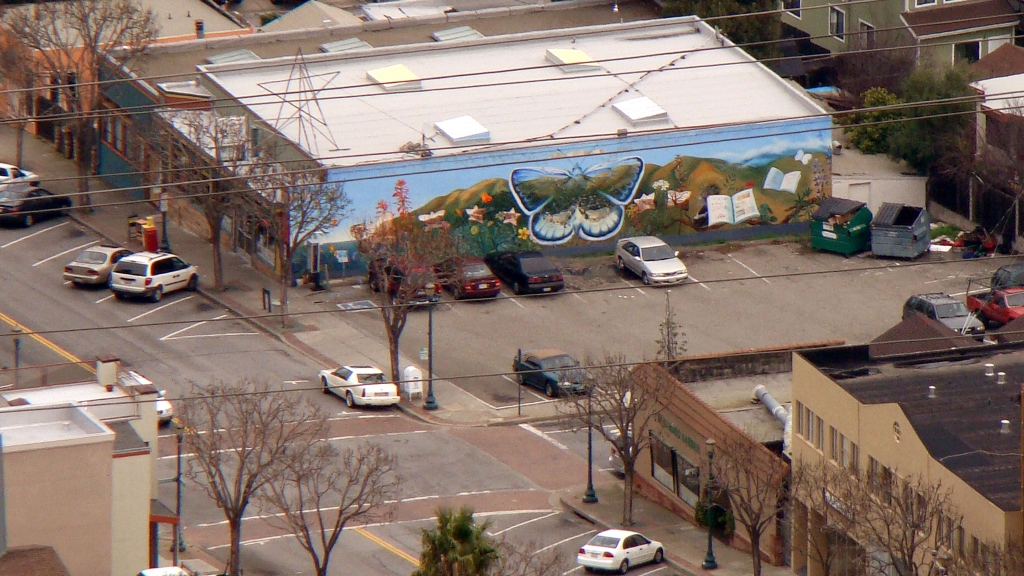
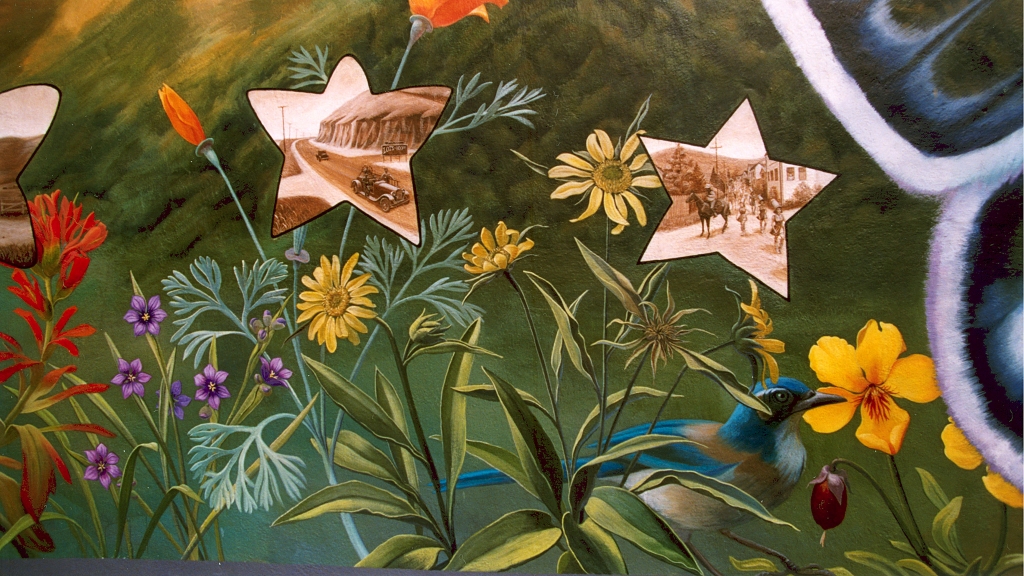
Inside the little sepia-images:
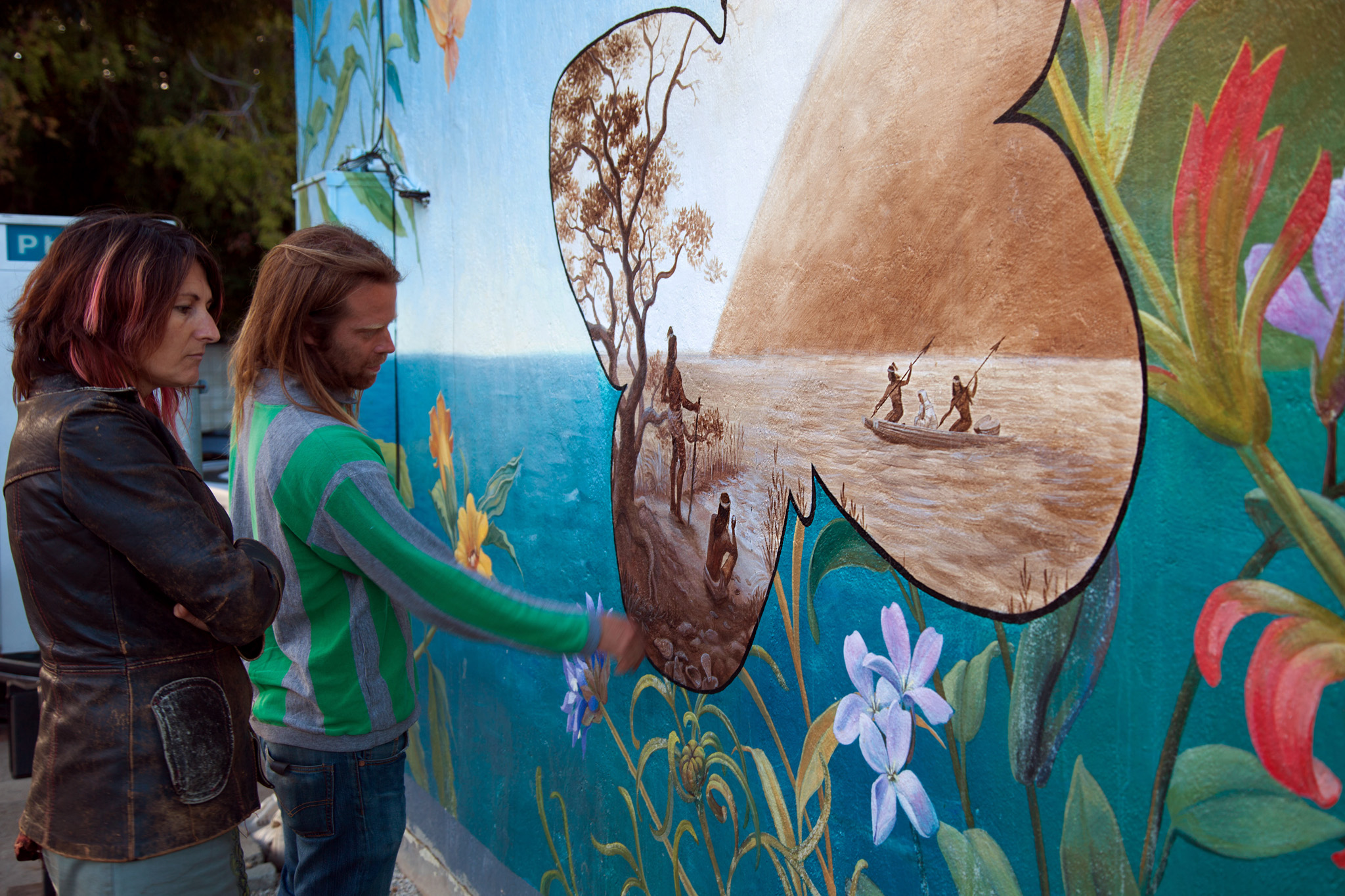
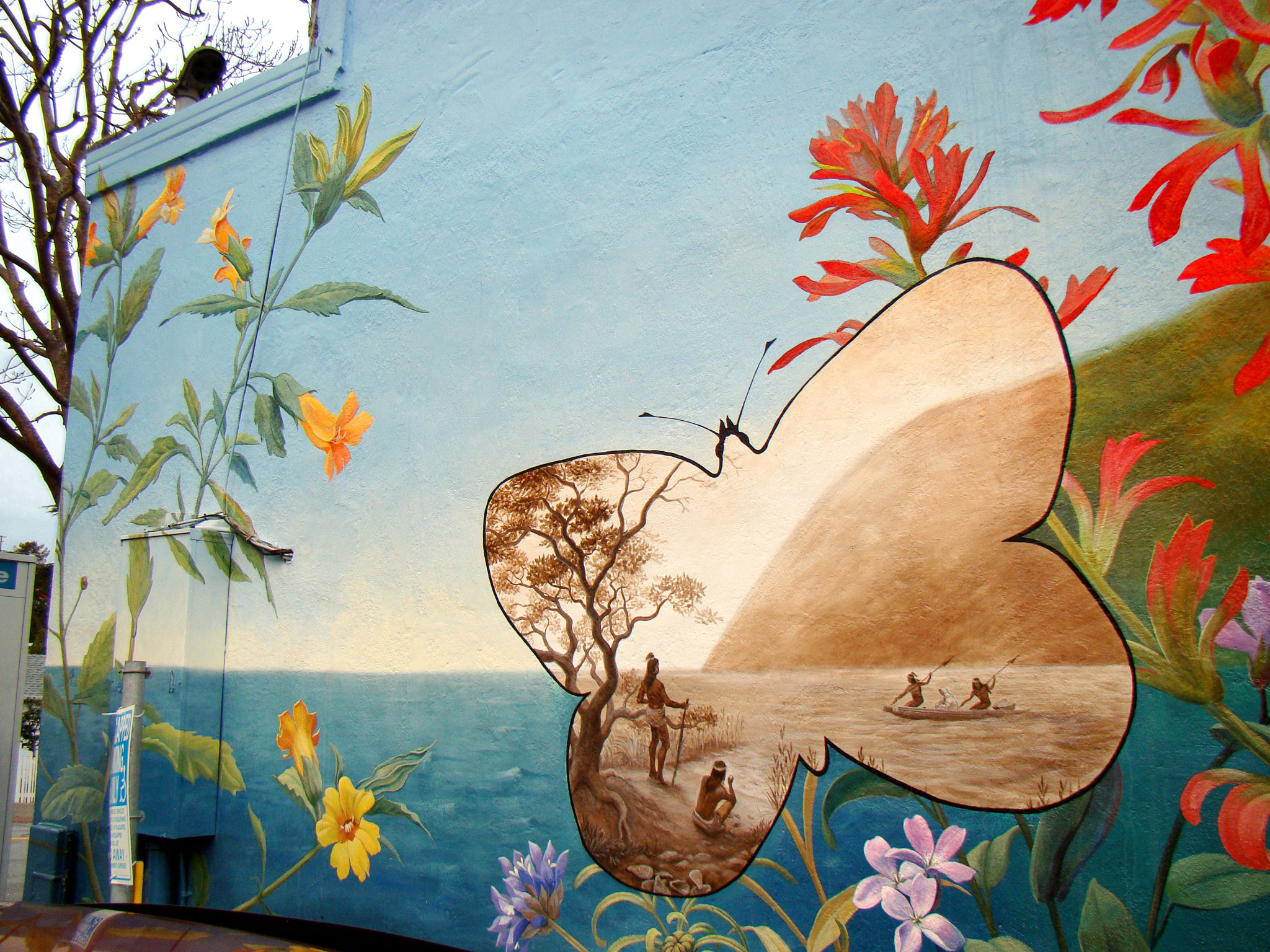
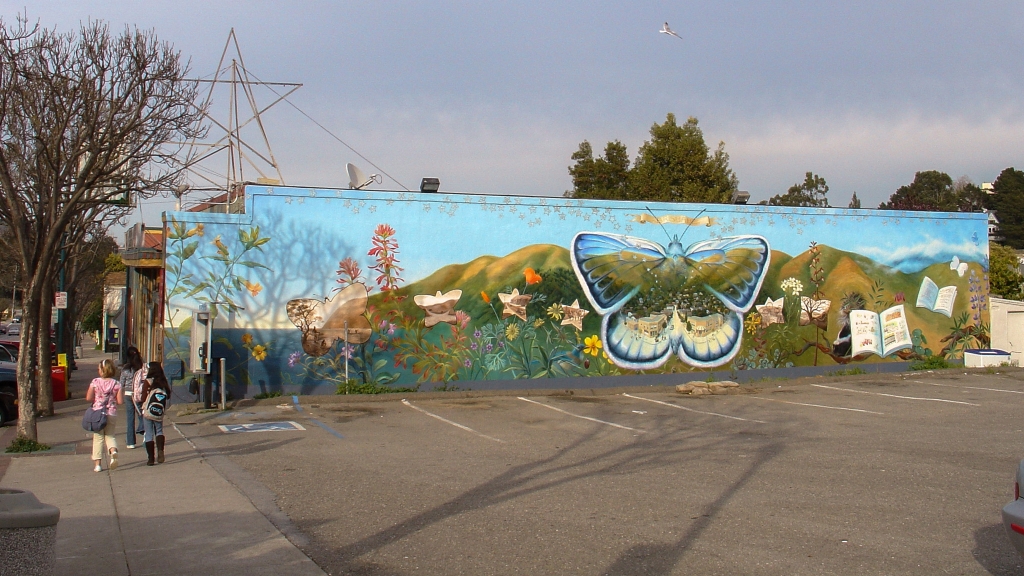
The first historical image depicts the native american Ohlone people, eating oysters and looking across the bay to the shore below San Bruno Mountain as it used to look like, before the bay was filled there.
The second vignette is based on a photograph dating 1913, and shows cattle ranches and two roads crossing, which would later become Brisbane's main streets: Visitacion Avenue and San Bruno Street.
The third image represents the 1930's, when a sign on Bayshore boulevard used to advertise lots for sale in Brisbane for $100. In the foreground, the first all-volunteer Brisbane Fire Department is shown, along with its first fire engine.
The following sepia image is set in the 1950's, and shows the "Western Days" festivities, which used to include a parade with horses and majorettes.
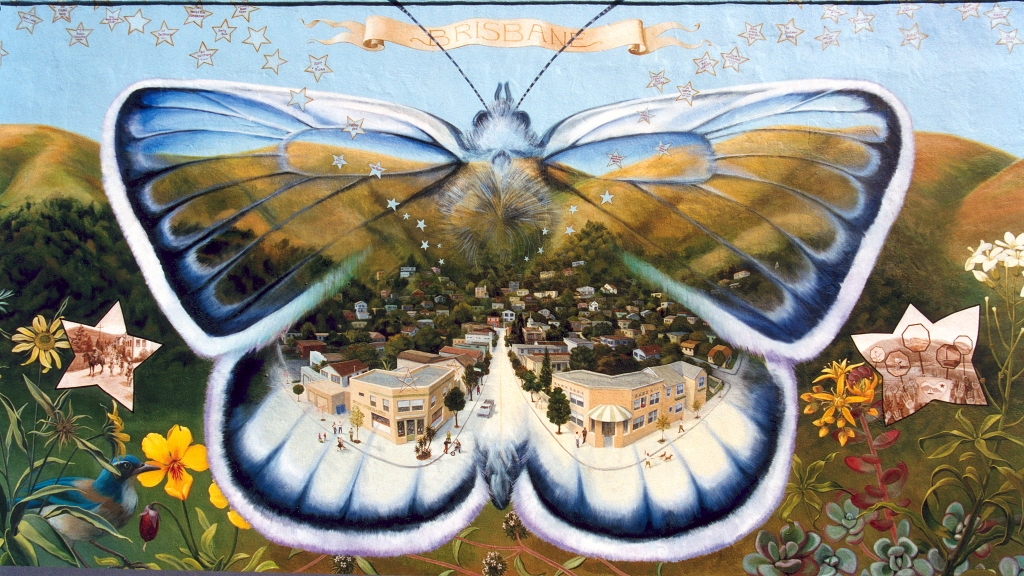
A contemporary view of Brisbane is painted in color in the center of the mural, within the shape of a Mission Blue butterfly, an endangered species native to San Bruno Mountain.
To the right of the butterfly, the fifth sepia vignette shows hands raised in a protective gesture in front of Brisbane and San Bruno Mountain. This represents the activism of the people of Brisbane, and the way they have shaped their community in recent decades. The see-though picket signs show parts of the landscape as it would have looked if the community had not intervened.
The picket signs are shaped like stop signs, and show several issues that have rallied the local community over the years. Among these are: stopping the landfill in the bay, stopping plans for the leveling and urbanization of San Bruno Mountain, stopping the construction of an incinerator, stopping the truck traffic on Quarry Road and the quarry itself, and stopping the spread of invasive plants.
The sixth vignette shows two amongst many contrasting lifestyles that exist around the edges of Brisbane: In the far background, the newest housing development on the Eastern Ridge (which was built on the sensitive habitat of several rare endemic species) offers a life with all amenities.
By contrast, in the foreground, the remarcable hand-made tree dwelling of local mountain hermits Besh and Thelma in Owl Canyon represents a very frugal but truly unique way of life.
The couple lived on the mountain for 12 years, but at the time this mural was being painted, their hobbit-like dwelling, was being threatened by county authorities, citing a law that prohibits living on the mountain. They were ultimately chased off and their home was destroyed in late 2002.
At the right end of the mural, the painted book contains artwork by 15 local children, whom I asked to imagine and draw a future Brisbane.
The book then flutters away becoming a Mission Blue butterly.
-------
Special thanks for spearheading this project to Dianne Washington, Lisa Worthington, and BEST.
Thanks also to David Schooley, Beth Grossman, Chris Carlsson, Jason Leonard, San Bruno Mountain Watch, and the town of Brisbane.